


The medical sector saves countless lives – and now, it is saving waste too. Since March 2022, the Dutch Flevo Hospital has been working with Seenons to tackle medical waste head-on. Every year, millions of kilograms of valuable raw materials are lost within healthcare, consisting of both Non-Clinical and Clinical Waste.
What is the goal? The collaboration with Flevo Hospital and Seenons aims to significantly reduce waste at Flevo Hospital and to cut residual waste by at least 25% by 2026, compared to 2018. This initiative supports the ambition of creating a more sustainable healthcare sector, with circular solutions at its core. The goals align with the guidelines and ambitions of the Green Deal Sustainable Healthcare 3.0.
What are Clinical Waste and Non-Clinical Waste?
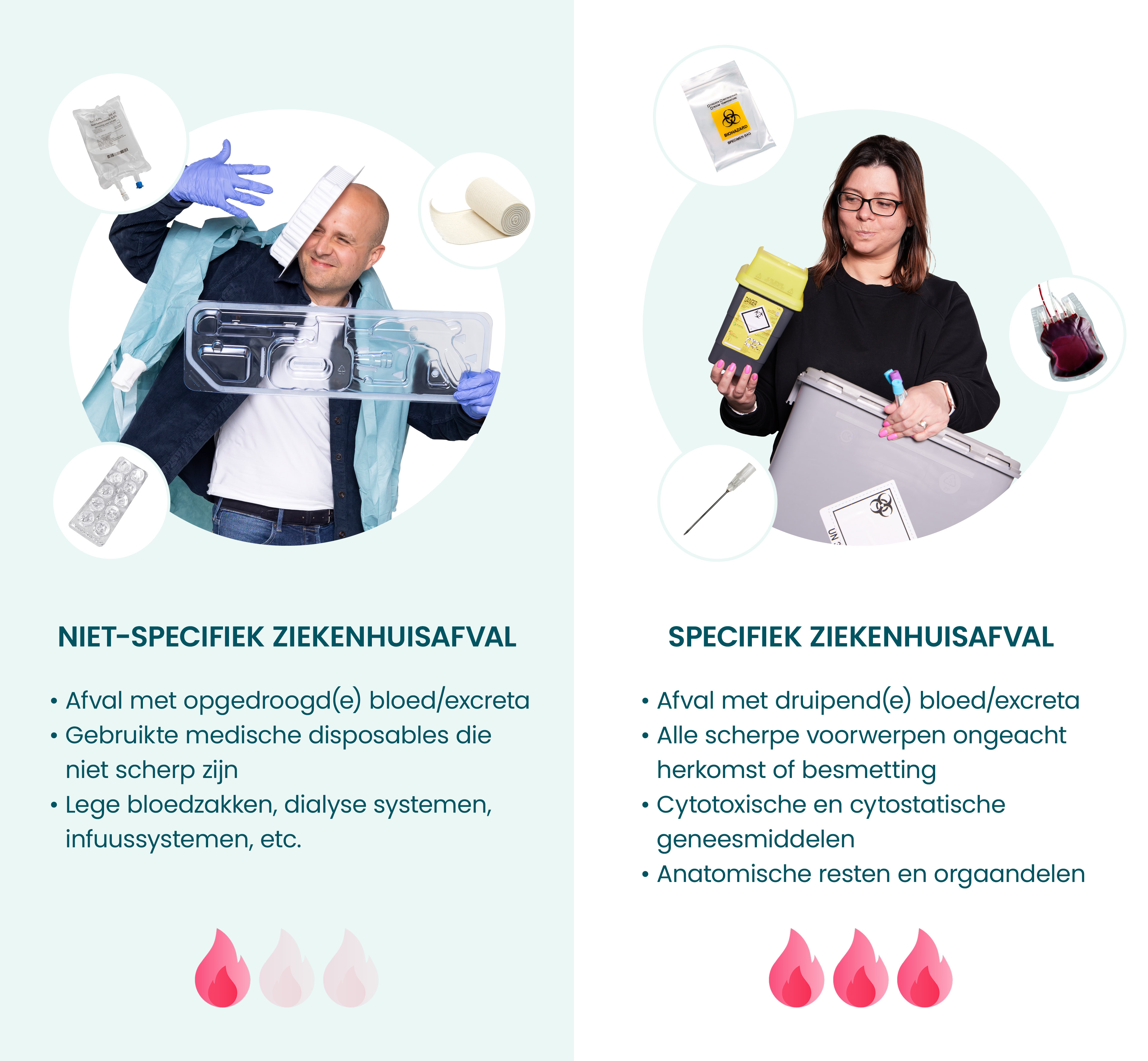
In hospitals, waste is divided into two main categories: Clinical Waste and Non-Clinical Waste.
Clinical Waste includes waste that directly results from medical procedures, such as injection needles and dressings soaked with blood. Due to infection risks and strict hygiene requirements, this waste stream is usually incinerated at extremely high temperatures, making it not only the most expensive but also the most polluting waste stream in a hospital.
Non-Clinical Waste, also known as residual waste, consists of all materials that do not fall under Clinical Waste and often cannot (yet) be collected separately. This waste originates from general hospital activities, such as packaging materials or tissues. While this stream poses fewer direct health risks, its large volume creates a significant environmental burden and high waste processing costs.
Although Flevo Hospital primarily focuses on reducing Non-Clinical Waste, Clinical Waste is not excluded from the approach. This stream is also analysed, and optimisation opportunities are explored. The goal is to improve overall waste management and make a broader impact within the healthcare sector. After all, it’s about the bigger picture.
https://www.afvalcirculair.nl/actueel/nieuws/afvalnieuws/2024/wel-specifiek-ziekenhuisafval/
Our approach: the five pillars of waste management
By actively focusing on waste separation, recycling and reuse, important steps are taken towards a more sustainable future. At Seenons, we work with five pillars: Procurement, Behaviour, Collection, Logistics and Processing. By keeping all five in mind, we ensure nothing in the material system is overlooked – including at Flevo Hospital.
Procurement: sustainability starts at the source
Waste prevention begins with conscious procurement of materials and products. That’s why Flevo Hospital, together with Seenons, focuses on purchasing materials that are reusable or recyclable. These conscious purchasing decisions allow valuable resources to be reused, minimising waste streams at the source. Regular evaluations of procurement processes help prevent unnecessary purchases and embed sustainability into daily operations.

Initiatives & results
- Blue wrap material: A concrete example is the switch to recyclable blue wrap material in the Central Sterilisation Department (CSA), expected to reduce the Non-Clinical Waste stream by approximately 2%. An even more sustainable option would be sterilisation containers, but these still pose challenges in terms of cost, time and space. The hospital is currently exploring the use of sterilisation containers as a reusable alternative.
Clinical Waste storage containers: Flevo Hospital has also found a more sustainable alternative for Clinical Waste storage containers. In collaboration with VE Systems, the hospital switched from virgin blue containers to grey containers made from recycled material. This results in significant environmental benefits and saves over €5,000 per year.
Behaviour: awareness and repetition for success
Behavioural change is an essential link in achieving Flevo Hospital’s sustainability goals. It’s not just about technological solutions, but about breaking habits and increasing awareness.
Initiatives & results
- Glove use: A key initiative focuses on reducing the use of non-sterile gloves. Many healthcare workers use new gloves for every patient contact, even when guidelines indicate this is often unnecessary. Inspired by the national campaign “No risk, no glove”, the hospital promotes awareness without compromising safety, rotating campaign materials across departments.
- Misconceptions: There is also strong focus on correcting misconceptions around waste separation, such as the assumption that all patient-related waste automatically falls under Clinical Waste. Targeted communication and training help employees distinguish between waste streams, leading to more efficient separation and a more sustainable mindset.
Behavioural change remains an ongoing process that requires continuous attention and repetition to ensure lasting impact.
Collection: innovations in medical waste separation
Due to strict regulations, Clinical Waste is often incinerated, but that does not mean recycling is impossible. It requires extra effort, research and collaboration to extract valuable materials from this stream.
Initiatives & results
- Medical staplers: Since 2022, Flevo Hospital and Seenons have worked with partners such as GreenCycl and Renewi to separate and recycle clinical components. One example is the source separation and processing of medical staplers. In one year, 1,000 kg of staplers were cleaned and recycled – accounting for 2% of the total Clinical Waste weight.
- Liquid waste streams: Flevo Hospital is currently exploring ways to optimise the disposal of liquid waste, such as suction fluids used during surgery. One technology under consideration is the Serres Nemo, which discharges liquids directly into the sewer instead of processing them as Clinical Waste. This would reduce incineration and lower costs.
- New waste streams: On the Non-Clinical Waste side, several optimisations have been implemented by adding new waste streams. CSA packaging materials and paper tissues are now collected separately. For recycling the latter, Flevo Hospital works via the Seenons platform with De Graaf, which ensures responsible processing and reuse of Tork paper towels.
These efforts demonstrate that even within strict medical waste regulations, reuse is possible when the right technologies and initiatives are applied.
Logistics: efficiency through smart solutions for worry-free service
Efficient logistics are essential for making the transport and processing of medical waste as sustainable as possible. Smart solutions reduce both costs and environmental impact. Seenons plays a key role in streamlining these logistics.
Like many customers, Flevo Hospital uses the Seenons platform to centrally manage collection requests for various waste streams. The platform provides insight into waste data and is continuously improved with new features for greater ease of use.
Initiatives & results
- New functionalities: A recent update allows hazardous waste processing to be requested directly via the app, providing detailed data that is automatically integrated into the hospital’s dashboard.
- Simpler communication: Improved processes eliminate the need for separate photos and additional forms, saving time and improving transparency.
- Reliability through data: The success rate of collection requests at Flevo Hospital is 98%, ensuring a reliable and worry-free experience.
- Time savings: Automated planning and processing save staff time, allowing them to focus on other tasks.
Processing: recycling IV bags as a breakthrough
Processing medical plastics such as IV bags is challenging due to their complex composition. These products, typically classified as Non-Clinical Waste, often end up being incinerated due to limited recycling options. However, targeted initiatives can enable separation, cleaning and reuse, significantly reducing environmental impact.
Flevo Hospital actively seeks more efficient and sustainable processing solutions.
Initiatives & results
- Recycling IV bags: In collaboration with Vinyl Recycling, Flevo Hospital recycled 1,000 kg of IV bags for the first time. These medical plastics were separated, cleaned and reused as part of the Bloody Serious Project, preventing incineration.
- New recycling partners: Since Vinyl Recycling is no longer active, Flevo Hospital is exploring new partnerships. Partners such as Blue2Green are being considered, potentially recycling 50–70% of the hospital’s Clinical Waste – equivalent to 25–35 tonnes per year.
- Next steps: Through innovative technologies and sustainable partnerships, the hospital continues to work towards a circular approach to medical plastics.
The future: Zero Waste at Flevo Hospital
Despite continued growth, Flevo Hospital is committed to further reducing non-recyclable waste. Through its Zero Waste Roadmap, the hospital aims to achieve the objectives set out in the Green Deal Sustainable Healthcare 3.0. By combining technology, behavioural change and collaboration, Flevo Hospital is taking meaningful steps towards a sustainable and circular future. With the recent five-year contract extension with Seenons, the path is open for new solutions and even greater impact.


